Evidence-based, parent-tested. References guidelines from the AAP, CDC, and WHO.
Informational only, not medical advice. Always consult your pediatrician about your baby's specific needs.
The period between 12 and 24 months is one of the most exciting — and most challenging — stages of your child’s life. Your baby is becoming a toddler before your eyes, transforming from a crawling, babbling infant into a walking, talking, opinion-having little person. The developmental leaps during this year are staggering: first steps become confident walking, single words become short sentences, and a growing sense of self leads to both heartwarming moments of affection and the occasional spectacular meltdown.
This guide walks you through what to expect in every area of development, what is typical toddler behavior (even when it feels anything but normal), and how you can support your child’s growing independence while keeping them safe.
📌 Key Takeaway: According to the AAP, developmental milestones occur in predictable patterns, but normal range can vary by 4-6 months. This guide gives you evidence-based, practical guidance you can apply today. For a related deep dive, see our guide on baby brain development nutrition.
Physical Milestones: From First Steps to Running
The gross and fine motor development that happens between 12 and 24 months is remarkable. Your child is gaining strength, coordination, and confidence in their body at a rapid pace.
Gross Motor Skills
12-15 months:
- Pulls to stand and stands independently
- Takes first independent steps (most children walk between 9-15 months)
- Walks with a wide stance and arms held up for balance (“toddler waddle”)
- May still prefer crawling for speed
- Can squat down to pick something up and stand back up
15-18 months:
- Walks with increasing confidence and narrower stance
- Begins to walk backward
- Tries to kick a ball (may miss or stumble)
- Climbs onto low furniture (couches, chairs)
- Can carry objects while walking
- Starts attempting to walk up stairs holding a hand or railing
18-24 months:
- Walks confidently, rarely falls
- Begins running (stiff, flat-footed gait)
- Kicks a ball forward
- Walks up and down stairs holding a rail (may place both feet on each step)
- Climbs playground structures, chairs, and tables
- Jumps with both feet off the ground (often closer to 24 months)
- Throws a ball overhand
- Rides push toys and may begin with ride-on toys
Fine Motor Skills
12-15 months:
- Uses a crude pincer grasp (thumb and forefinger) to pick up small objects
- Bangs two objects together intentionally
- Puts objects in and out of containers
- Turns pages in a board book (several at a time)
- Begins using a spoon (very messy)
- Drinks from a cup with help
15-18 months:
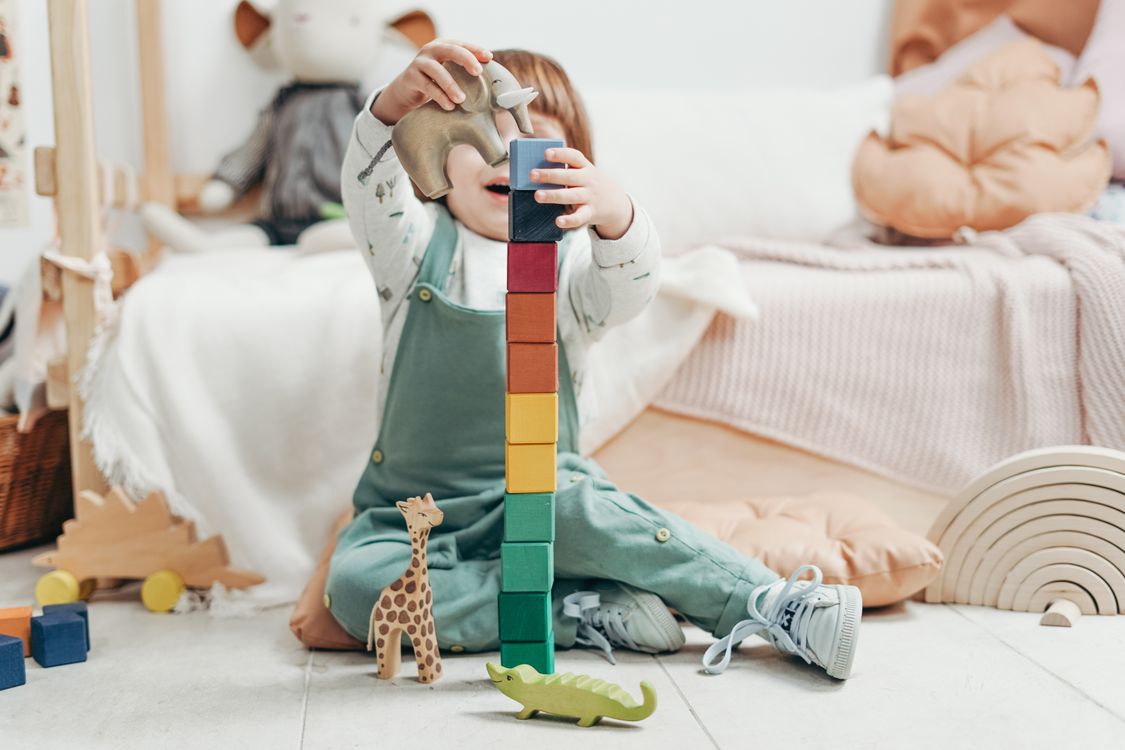
- Stacks 2-3 blocks
- Scribbles with a large crayon
- Turns pages more deliberately
- Uses a spoon with moderate success
- Takes off shoes and socks
- Points with index finger
18-24 months:
- Stacks 4-6 blocks
- Turns door handles
- Unscrews lids
- Turns single pages in a book
- Uses a spoon and fork with increasing skill
- Drinks from an open cup with less spilling
- Begins to show hand preference (though hand dominance may not be established until age 3-4)
- Scribbles spontaneously and may imitate drawing lines
Language Development: The Vocabulary Explosion
Perhaps no area of development is more dramatic between 12 and 24 months than language. Many parents are amazed by how quickly their toddler goes from a handful of words to full (if simple) sentences.
Receptive Language (Understanding)
Receptive language — what your child understands — develops ahead of expressive language. Your toddler likely understands far more than they can say:
12-15 months:
- Understands approximately 50-100 words
- Follows simple one-step directions (“Give me the cup”)
- Responds to their name consistently
- Recognizes names of familiar people, pets, and objects
- Understands “no” (even if they choose to ignore it)
15-18 months:
- Understands 100-150 words
- Points to several body parts when named
- Follows directions with familiar objects (“Put the ball in the box”)
- Understands simple questions (“Where is your shoe?”)
- Recognizes pictures of familiar objects in books
18-24 months:
- Understands 200-300+ words
- Follows two-step directions (“Pick up the toy and bring it to me”)
- Understands simple pronouns (me, you, mine)
- Can point to pictures in a book when named
- Understands the concept of “one more”
Expressive Language (Speaking)
12-15 months:
- Says 2-6 words (often “mama,” “dada,” “no,” “uh-oh”)
- Uses gestures extensively (pointing, reaching, waving, shaking head)
- Babbles in long strings that sound like conversation (“jargon babbling”)
- May use one word to mean many things (“ba” for ball, bottle, and bath)
15-18 months:
- Vocabulary of approximately 10-20 words
- Begins naming familiar objects
- Starts using words instead of gestures more often
- May use “no” frequently (and emphatically)
- Still relies heavily on jargon babbling mixed with real words
18-24 months — The “Word Explosion”:
- Vocabulary grows rapidly, often adding several new words per week
- By 18 months: approximately 50 words is a common benchmark
- By 24 months: approximately 200-300 words for many children
- Begins combining two words (“more milk,” “daddy go,” “big truck”)
- Starts using simple pronouns (“me,” “mine”)
- Asks “What’s that?” frequently
- Strangers can understand approximately 50% of speech by 24 months
Supporting Language Development
- Talk constantly — narrate your day, describe what you see, explain what you are doing
- Expand on your toddler’s words — if they say “dog,” respond with “Yes, a big brown dog!”
- Read together every day — point to pictures, ask questions, let your child turn pages
- Sing songs and nursery rhymes — repetition and rhythm support language learning
- Give your child time to respond — pause after asking a question; do not rush to fill the silence
- Avoid baby talk — use real words and clear pronunciation
- Limit screen time — live, face-to-face interaction is far more effective for language learning than any app or video
Cognitive Leaps: How Your Toddler Thinks
Between 12 and 24 months, your child’s cognitive abilities expand dramatically. They are transitioning from purely sensory-motor thinking (learning through touching and mouthing) to symbolic thinking (understanding that things can represent other things).
Key Cognitive Developments
Object permanence matures:
- Understands that objects exist even when hidden
- Can find a toy hidden under multiple covers
- This is why separation anxiety may peak — they know you exist even when they cannot see you
Cause and effect:
- Deliberately pushes buttons to make toys work
- Understands that pulling a string makes a toy move
- Realizes that throwing food gets a reaction (not the best experiment, but a cognitive milestone nonetheless)
Sorting and categorizing:
- Begins sorting objects by shape, color, or size
- Matches identical objects
- Puts shaped blocks into a shape sorter (12-18 months: round hole first; by 24 months: more complex shapes)
Pretend play emerges:
- Pretends to feed a doll or stuffed animal (around 15-18 months)
- Uses objects symbolically (a block becomes a phone, a box becomes a boat)
- Imitates household activities (sweeping, cooking, talking on the phone)
- By 24 months, pretend play becomes more elaborate and creative
Problem-solving:
- Uses a stick to reach a toy
- Tries different approaches when something does not work
- Stacks and nests objects in order of size
- Follows two-step instructions (“Get your shoes and bring them to Mommy”)
Memory and learning:
- Remembers where toys are kept
- Anticipates routines (gets excited when they see the bath being prepared)
- Imitates actions seen hours or days earlier (deferred imitation)
- Recognizes familiar places, routes, and people
Social-Emotional Growth: Big Feelings in a Small Body
The social-emotional development of a toddler is complex, fascinating, and often the source of the most parenting challenges. Your child is developing a sense of self, learning to navigate emotions, and discovering that they are a separate person from you — with their own desires.
What to Expect
Growing independence:
- Wants to do things “by myself” (even when they physically cannot)
- Resists help with dressing, eating, or climbing
- May insist on choosing their own clothes, food, or activities
- Says “no” and “mine” frequently — this is healthy self-assertion, not defiance
Tantrums:
- Tantrums typically begin around 12-15 months and peak between 18-24 months
- They happen because toddlers feel strong emotions but lack the brain development and language skills to manage them
- Common triggers: frustration, hunger, tiredness, transitions, not getting what they want, being unable to communicate
- Tantrums are developmentally normal and NOT a sign of bad parenting
Parallel play:
- Toddlers play alongside other children rather than cooperatively with them
- They may watch, imitate, or sit near peers but rarely engage in shared play
- True cooperative play develops later (around 3-4 years)
- Sharing is extremely difficult at this age — possessiveness is normal
Emerging empathy:
- May show concern when someone is crying or upset
- May offer a comfort object (their blanket or stuffed animal) to someone who is sad
- True empathy is still developing, but these early signs are meaningful
Attachment behaviors:
- May become clingy during new situations, with new people, or during developmental leaps
- Separation anxiety can be intense (especially around 12-18 months)
- Uses the parent as a “secure base” — ventures out to explore, then returns for reassurance
Typical (and Exhausting) Toddler Behaviors
These behaviors are normal, even though they can drive parents to the edge. Understanding why they happen can help you respond with patience:
Throwing things:
- Your toddler is experimenting with cause and effect and learning about gravity and trajectory
- They are also learning about their own strength and coordination
- Provide appropriate throwing opportunities (soft balls, beanbags outdoors)
Biting:
- Peaks between 12-18 months and usually decreases as language improves
- Causes: frustration, overstimulation, teething, exploring, or trying to communicate
- Respond calmly: “No biting. Biting hurts.” Offer an alternative (“You can bite this teething ring”)
- Usually resolves by age 3
Saying “no” to everything:
- Even things they want (“Do you want ice cream?” “NO!”)
- This is about practicing autonomy, not about the actual answer
- Offer limited choices instead of yes/no questions (“Do you want the red cup or the blue cup?”)
Hitting or pushing:
- Impulse control is not developed yet — the prefrontal cortex is years from mature
- Toddlers act on impulse before they can think about consequences
- Stay calm, set limits consistently, and model gentle touch
Self-Care Skills: Growing Independence
Between 12 and 24 months, toddlers begin taking on small self-care tasks that build confidence, fine motor skills, and independence.
Eating and Drinking
- 12-15 months: Uses a spoon (very messy), drinks from a sippy cup or straw cup, finger-feeds most foods
- 15-18 months: Spoon use improves, can drink from an open cup with both hands (expect spills), may use a fork to stab soft foods
- 18-24 months: Feeds self with spoon and fork with moderate success, drinks from an open cup with less spilling, may start to show food preferences and refusals
Tip: Let your toddler practice with real utensils and real cups. The mess is temporary; the skills are lasting. Offer a pre-loaded spoon if independent scooping is too frustrating.
Dressing
- 12-15 months: Cooperates with dressing by pushing arms through sleeves or feet into shoes
- 15-18 months: Pulls off shoes, socks, and hats; may attempt to pull off shirt
- 18-24 months: Helps pull pants up and down, unzips large zippers, takes off loose clothing independently
Tip: Provide easy-on, easy-off clothing (elastic waistbands, velcro shoes, loose shirts) to encourage independence.
Hygiene
- 12-15 months: Holds hands under water, may imitate tooth brushing
- 15-18 months: Wipes face with a cloth when prompted, enjoys water play during bath
- 18-24 months: Washes hands with help, brushes teeth with assistance (parent should do the thorough brushing), may show interest in the toilet (but readiness for toilet training varies widely)
Toddler-Proofing Your Home
As your child becomes mobile and increasingly curious, your home needs to evolve with them. Toddlers are faster, more resourceful, and more determined than you might expect.
Critical Safety Updates for 12-24 Months
- Secure furniture to walls — bookshelves, dressers, and TVs can topple when a toddler climbs
- Install gates at the top and bottom of stairs
- Lock cabinets containing cleaning products, medications, sharp objects, and small items
- Cover electrical outlets and secure cords
- Move chairs away from counters and tables — toddlers will climb
- Check for choke hazards — anything smaller than a toilet paper roll is a risk
- Lock doors to bathrooms, laundry rooms, and garages
- Lower crib mattress to the lowest setting; transition to a toddler bed if your child is climbing out
- Keep hot liquids out of reach — burns are a leading cause of injury in this age group
- Fence pools and water features — even small amounts of water are drowning risks
Discipline and Limit-Setting for Toddlers
Discipline at this age is about teaching, not punishment. Your toddler’s brain is not capable of understanding consequences the way an older child or adult does. Effective approaches focus on safety, consistency, and connection.
Effective Strategies
Set clear, simple limits:
- Use short, concrete phrases: “We walk inside,” “Food stays on the plate,” “Gentle hands”
- State what you WANT them to do, not just what you do not want: “Feet on the floor” rather than “Stop climbing”
Redirect, redirect, redirect:
- When your toddler is doing something unacceptable, guide them toward an acceptable alternative
- “You cannot throw blocks, but you CAN throw this soft ball”
Use natural consequences when safe:
- If they throw their food, the meal is done
- If they refuse a coat, they briefly feel cold (with you ready with the coat)
Validate feelings while holding limits:
- “You are really angry that I took the marker. You wanted to draw on the wall. We draw on paper. Here is some paper.”
- Acknowledging feelings does not mean giving in
Be consistent:
- Toddlers are testing limits to understand the rules — this is their JOB
- If a rule changes constantly, they cannot learn it
- Both caregivers should be on the same page about major limits
Stay calm:
- Your toddler is watching how YOU handle frustration
- If you yell, they learn that yelling is how adults handle big feelings
- Take a breath. It is okay to say, “Mommy needs a minute to calm down”
What Does NOT Work
- Spanking or physical punishment: Research is clear that it increases aggression, harms the parent-child relationship, and does not teach appropriate behavior
- Time-outs for children under 2: Most toddlers under 2 do not have the cognitive capacity to understand time-outs
- Long explanations: Your toddler cannot process a paragraph of reasoning; keep it to one short sentence
- Expecting perfection: They will repeat unwanted behaviors many, many times. This is normal brain development, not willful disobedience
Encouraging Independence Safely
The push for independence is one of the defining features of toddlerhood. Rather than fighting it, channel it:
Practical Ways to Foster Independence
- Offer two choices (not open-ended ones): “Red shirt or blue shirt?” “Apple or banana?”
- Create a “yes” environment — set up spaces where your toddler can freely explore without constant “no”
- Let them try — even if it takes longer and makes a mess
- Provide child-sized tools — a low step stool, small utensils, a child-height table
- Build in extra time — rushing a toddler who wants to do it themselves is a recipe for meltdowns
- Celebrate effort — “You put your shoe on! You worked really hard on that!”
- Allow safe risk-taking — climbing at a playground, jumping off a low step, carrying their own plate
- Create routines they can participate in — putting dirty clothes in the hamper, feeding a pet, wiping a spill
When to Talk to Your Pediatrician
While the range of normal is wide, there are some signs that warrant a conversation with your child’s doctor:
- Not walking by 18 months
- Fewer than 6 words by 18 months
- No two-word phrases by 24 months
- Loss of skills they previously had (regression)
- Not pointing to show you things by 18 months
- Does not imitate actions or words
- Does not follow simple instructions by 24 months
- Not engaging in pretend play by 24 months
- No interest in other children
- Extreme difficulty with transitions or changes in routine
Remember that developmental milestones are ranges, not deadlines. But if you have a gut feeling that something is off, trust it. Early evaluation and support can only help.
Frequently Asked Questions
My 14-month-old is not walking yet. Should I be worried?
Most children walk between 9 and 15 months, with the average being around 12 months. Walking at 14 months is within the normal range. If your child is pulling to stand, cruising along furniture, and showing interest in moving, they are likely on track. However, if there is no walking by 18 months, talk to your pediatrician about a developmental evaluation.
How many words should my 18-month-old say?
The CDC milestone checklist indicates that most children have at least 6 words by 18 months. Many have closer to 20-50. Expressive vocabulary varies widely at this age. More important than the exact number is whether your child is steadily adding new words, using gestures to communicate, and understanding far more than they say. If your child has fewer than 6 words at 18 months, discuss it with your pediatrician.
Are tantrums normal at 15 months?
Absolutely. Tantrums are one of the most normal aspects of toddler development. They begin as early as 12 months and typically peak between 18 and 24 months. Tantrums happen because your child has strong feelings and desires but lacks the brain maturity and language skills to express or manage them. The best responses are to stay calm, keep your child safe, validate their feelings, and wait it out.
When should my toddler start sharing?
True sharing is a developmental skill that most children do not master until age 3-4. Between 12 and 24 months, possessiveness and “mine” are completely normal and healthy expressions of their developing sense of self. You can model sharing and taking turns, but do not expect consistent voluntary sharing during this period. Parallel play (playing alongside peers rather than with them) is the norm.
How do I handle biting?
Biting is common between 12 and 24 months and usually decreases as language skills improve. When biting occurs, respond immediately and calmly: remove your child from the situation, say firmly “No biting. Biting hurts,” and comfort the child who was bitten. Offer an alternative for the biter (“You can bite this teething toy”). Avoid biting back, as this teaches that biting is an acceptable response.
Should I worry about my toddler’s picky eating?
Some degree of food selectivity is normal and expected between 12 and 24 months. Toddlers are developing independence and preferences, and their growth rate naturally slows (so appetite decreases). Continue offering a variety of foods without pressure, eat together as a family when possible, and avoid making separate “kid meals.” If your child’s growth is tracking normally and they eat from a reasonable variety of food groups over the course of a week, picky eating is unlikely a concern. Talk to your pediatrician if your child is losing weight, eating fewer than 10 foods total, or refusing entire food groups.
💡 Related Resources: Expecting? Visit our sister site pregnancy.chparenting.com for week-by-week pregnancy guides, prenatal nutrition, and labor preparation.
References
- Centers for Disease Control and Prevention. Developmental Milestones. https://www.cdc.gov/ncbddd/actearly/milestones/index.html
- American Academy of Pediatrics. Caring for Your Baby and Young Child: Birth to Age 5. https://www.healthychildren.org/
- Mayo Clinic. Toddler Development. https://www.mayoclinic.org/healthy-lifestyle/infant-and-toddler-health/in-depth/toddler-development/art-20049089
- Zero to Three. Toddler Development. https://www.zerotothree.org/
- American Speech-Language-Hearing Association (ASHA). Speech and Language Developmental Milestones. https://www.asha.org/public/speech/development/
- Gershoff, E. T. (2013). Spanking and Child Development: We Know Enough Now to Stop Hitting Our Children. Child Development Perspectives, 7(3). https://doi.org/10.1111/cdep.12038
- World Health Organization. Improving Early Childhood Development: WHO Guideline. https://www.who.int/publications/i/item/97892400020986

Written by
Vega LinFounder & Editor — Mother of 2 (Taiwan)
Vega writes Baby Care Guide from the intersection of evidence-based research (AAP, CDC, WHO) and real parenting experience. Holds a Master's in Digital Innovation from Tunghai University. Read more →
Related articles



Planning baby #2? Visit our pregnancy guide.
Due date calculators, week-by-week tracking, weight gain guides, and expert articles for every trimester of your pregnancy journey.
Visit Pregnancy Guide →